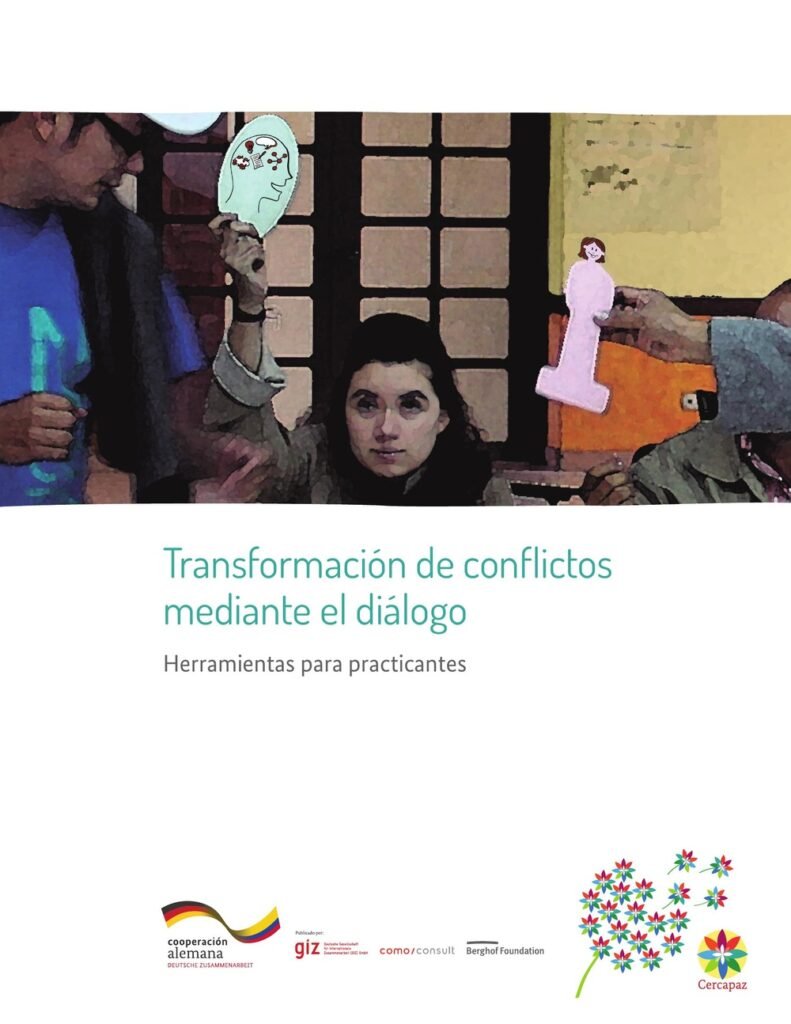
Conflict Transformation through Dialogue. Tools for Practitioners
Authors: María Paula Prada; Barbara Unger; Jaime Andrés Gómez
Published by: Deutsche Gesellschaft für Internationale Zusammenarbeit (GIZ) GmbH – Cercapaz Programme, Cooperation between State and Civil Society for Peacebuilding
Supported by / commissioned by: Cercapaz Programme, implemented by GIZ on behalf of the German Federal Ministry for Economic Cooperation and Development (BMZ). The publication involved the COMO Consult/Berghof Foundation Consortium.
Year of publication: 2014
Place of publication: Bogotá D.C., Colombia
Number of pages: 161 pages in the digital file
Resource type: Toolkit / methodological guide
Usage rights: Reproduction and circulation for non-commercial purposes are permitted, provided that the source is properly cited and the copyright of Deutsche Gesellschaft für Internationale Zusammenarbeit (GIZ) GmbH is respected.
¡Resumen generado por ClustorBot!
This toolkit provides concepts, methodologies and practical resources for people who promote and facilitate dialogue processes aimed at transforming conflicts. Its contents were developed and tested through training and practical application with dialogue practitioners in Colombia. The publication introduces conceptual approaches to conflict and dialogue, examines the roles of different actors, and describes the principles and characteristics required of dialogue practitioners. It proposes a working pathway comprising exploration, analysis, design, implementation and follow-up, understood as an iterative and non-linear process. It also develops skills and competencies related to communication, questioning, facilitation and self-reflection, and presents tools such as stakeholder mapping, conflict analysis matrices, connectors and dividers, the tetralemma, role-playing, appreciative inquiry and timelines. As a transversal component, it includes the Integrative Conflict Transformation (ICT) model, which focuses on preparing conflict parties to address relational and deeper dimensions of conflict.
Key contents:
- Conceptual foundations for understanding conflict, violence, dialogue and conflict transformation.
- Phases and tools for exploring, analysing, designing, implementing and following up dialogue processes.
- Roles, principles and competencies of dialogue practitioners and facilitators.
- Methodological tools for communication, participation, analysis, facilitation and self-reflection.
- Integrative Conflict Transformation (ICT) model as a practical approach to conflict transformation through dialogue.